


DK pistons, junk or good?
- Thread starter flyinwrenches
- Start date
You are using an out of date browser. It may not display this or other websites correctly.
You should upgrade or use an alternative browser.
You should upgrade or use an alternative browser.
Thank you, I will give him a call Monday and talk to him. Thanks again!

Perhaps something has changed in the last couple years, but another big name here said to stay far away from the Dualoy / UEM (KB more or less). Had a seen some crack
Here is how I see it. The 6.4l fords and duramaxs have piston cracking issues. Everyone blames the piston composition and design, which is somewhat correct, but there are also many other factors that can cause a piston to go toes up. For instance, bad injector spray patters will superheat some spots and cool others, you also have unburned and nonatomized fuel that sets there on the piston and can cause a bad detonation event that, guess what, cracks the piston. There is also coolant from a pinhole in the head gasket. If a tiny, tiny amount of coolant mixed with the atomized fuel, guess what, it predetonates and cracks a piston...ask dodge about that one. They been torching their intakes because of this. Then there is the guys wanting to turn their rigs to over 1000 hp and run their egts to the moon. Nothing is wrong with a little fun, but fun cost money and stuff breaks. There is many other factors as well that contribute to piston failures or cracks, that are not always to blame on the piston manufacturer, but on other component failures or the improper matched and paired components. For example, on the lmls, guys turn their trucks up with an 80hp tow tune and tow 40,000 pounds behind it and snap the crank. I have fixed 6 broken cranks that are owned by cattle haulers for sale barns. They are pulling a 40 ft aluminum trailers stomped full of cattle. Not only did they not do any supporting hard part mods, but they over exceeded the tow rating. Then these guys bitch about how crappy the cranks are on their duramax. I know a cattle hauler who broke 3 cranks on 3 trucks. He went to ford f450 this year. Anyways, is that the cranks fault or GMs? Maybe somewhat, but not entirely. You see where I am going with this. I would bet you could cracks of melt holes in every single piston that exist on planet earth with the right amount of circumstances. That's my take on it and that's really how it is from where I am standing.Perhaps something has changed in the last couple years, but another big name here said to stay far away from the Dualoy / UEM (KB more or less). Had a seen some crack


Perhaps something has changed in the last couple years, but another big name here said to stay far away from the Dualoy / UEM (KB more or less). Had a seen some crack
I wouldnt use them on a truck pushing 700+ hp. I like them for stock rebuilds or lightly modded. Maybe a truck i know that will run good tuning and more air than fuel.
Fingers are still my go to/push for anything 700 and up because i know that will not be their problem.
Thanks man, I am going to holler at him Monday, if I have time. I don't want to bother him on the weekend. I appreciate it!K&D Service Inc
Call or Text: 906-284-0962
Providing a "one-stop-shop" for all of your automotive needs!

I'm going to argue that the underlined is mostly incorrectHere is how I see it. The 6.4l fords and duramaxs have piston cracking issues. Everyone blames the piston composition and design, which is somewhat correct, but there are also many other factors that can cause a piston to go toes up. For instance, bad injector spray patters will superheat some spots and cool others, you also have unburned and nonatomized fuel that sets there on the piston and can cause a bad detonation event that, guess what, cracks the piston. There is also coolant from a pinhole in the head gasket. If a tiny, tiny amount of coolant mixed with the atomized fuel, guess what, it predetonates and cracks a piston...ask dodge about that one. They been torching their intakes because of this. Then there is the guys wanting to turn their rigs to over 1000 hp and run their egts to the moon. Nothing is wrong with a little fun, but fun cost money and stuff breaks. There is many other factors as well that contribute to piston failures or cracks, that are not always to blame on the piston manufacturer, but on other component failures or the improper matched and paired components. For example, on the lmls, guys turn their trucks up with an 80hp tow tune and tow 40,000 pounds behind it and snap the crank. I have fixed 6 broken cranks that are owned by cattle haulers for sale barns. They are pulling a 40 ft aluminum trailers stomped full of cattle. Not only did they not do any supporting hard part mods, but they over exceeded the tow rating. Then these guys bitch about how crappy the cranks are on their duramax. I know a cattle hauler who broke 3 cranks on 3 trucks. He went to ford f450 this year. Anyways, is that the cranks fault or GMs? Maybe somewhat, but not entirely. You see where I am going with this. I would bet you could cracks of melt holes in every single piston that exist on planet earth with the right amount of circumstances. That's my take on it and that's really how it is from where I am standing.
The biggest contributor to cracking a piston is excessive cylinder pressure and / or EGT
Liquid fuel on the piston is going to boil not detonate
Coolant and or water cools the combustion. Water injection has been done for decades and unless they are hydro locking their engines, it's not really a factor in piston damage. In fact many have used it to make them live longer.
Yes and no, perhaps I worded it wrong. You are correct. However, the fuel on the piston does cause issues and also washes the oil film off the cylinders. I had a peterbilt the other day that stuck an injector and scored the cylinder wall and broke the piston. I may have been wrong about the "science" part of it, but running one with a hung injector ends up in having a really bad day. They will knock like hell when they start overfueling and blowing a huge cloud of white smoke. Your oil gets dieseled out too and will start getting really thin. The old cats, cummins, and detroits are mechanical injection though. I would almost imagine that the common railed trucks with electronic injectors can adapt for it better in the fuel timing. The old rigs will sound like they're going to throw a rod through the block when they have a bad injector. If that isn't predetonation, then what is it? The coolant issue, well I don't understand that one myself, but dodge issued a service bulletin on their new vehicles stating the egr cooler leaks into the egr crossover and cause combustion?? They have a recall over it. It was causing super hot gases that is melting their intake manifolds. I haven't seen one crack a piston, but if it's getting that hot, then I don't imagine it's doing them any good. I don't know why I said head gasket. I was wrong on that. Anyways, failing emissions crap is what they was referring to. The service bulletin said a small leak in the egr cooler. I think they mean a hot exhaust gas leak, but coolant runs through it too. I am not sure what's going on there. There can be coolant residue in the melted manifold, so I don't know on that one. I agree though, a failing head gasket probably won't crack the piston, unless it is hydrolocking it or something weird happened. So, yeah, I am wrong on that.I'm going to argue that the underlined is mostly incorrect
The biggest contributor to cracking a piston is excessive cylinder pressure and / or EGT
Liquid fuel on the piston is going to boil not detonate
Coolant and or water cools the combustion. Water injection has been done for decades and unless they are hydro locking their engines, it's not really a factor in piston damage. In fact many have used it to make them live longer.
Last edited:
Here's what a quick google search said about it...
"A plastic intake manifold can melt due to extreme heat from a failing EGR cooler, which causes internal combustion and damage to the manifold, potentially leading to a vehicle fire. Manufacturers like Volvo and Ram/Jeep have issued recalls for EGR cooler issues, as this can lead to symptoms like a loss of power, smoke, a burning plastic smell, and the intake manifold itself melting."
Of course, a plastic intake manifold is stupid to begin with.
"A plastic intake manifold can melt due to extreme heat from a failing EGR cooler, which causes internal combustion and damage to the manifold, potentially leading to a vehicle fire. Manufacturers like Volvo and Ram/Jeep have issued recalls for EGR cooler issues, as this can lead to symptoms like a loss of power, smoke, a burning plastic smell, and the intake manifold itself melting."
Of course, a plastic intake manifold is stupid to begin with.
Last edited:

01-05 duramax didn’t have piston issues. You could take a set of 300,000 mile pistons delip them and run them at 800hp and get good life out of them. People would run 3300 pulse and weren’t concerned about them. In 06 everything changed, stock trucks were cracking pistons. Sure you can make sure your setup is easy on pistons but you can still crack them if you choose the wrong ones. Why would anyone risk their entire motor to save a few bucks.Here is how I see it. The 6.4l fords and duramaxs have piston cracking issues. Everyone blames the piston composition and design, which is somewhat correct, but there are also many other factors that can cause a piston to go toes up. For instance, bad injector spray patters will superheat some spots and cool others, you also have unburned and nonatomized fuel that sets there on the piston and can cause a bad detonation event that, guess what, cracks the piston. There is also coolant from a pinhole in the head gasket. If a tiny, tiny amount of coolant mixed with the atomized fuel, guess what, it predetonates and cracks a piston...ask dodge about that one. They been torching their intakes because of this. Then there is the guys wanting to turn their rigs to over 1000 hp and run their egts to the moon. Nothing is wrong with a little fun, but fun cost money and stuff breaks. There is many other factors as well that contribute to piston failures or cracks, that are not always to blame on the piston manufacturer, but on other component failures or the improper matched and paired components. For example, on the lmls, guys turn their trucks up with an 80hp tow tune and tow 40,000 pounds behind it and snap the crank. I have fixed 6 broken cranks that are owned by cattle haulers for sale barns. They are pulling a 40 ft aluminum trailers stomped full of cattle. Not only did they not do any supporting hard part mods, but they over exceeded the tow rating. Then these guys bitch about how crappy the cranks are on their duramax. I know a cattle hauler who broke 3 cranks on 3 trucks. He went to ford f450 this year. Anyways, is that the cranks fault or GMs? Maybe somewhat, but not entirely. You see where I am going with this. I would bet you could cracks of melt holes in every single piston that exist on planet earth with the right amount of circumstances. That's my take on it and that's really how it is from where I am standing.
Yeah, your right. I agree. I guess all a person can do is try to get the very best parts they can and then if anything happens, at least you did all you could to prevent it....I get that. I am just going OE Mahle. I could go better, but I think they will do just fine. I am shipping the dk ones back tommorow. Anyways, if the mahle pistons give problems, then its alright, I don't really get to upset when stuff breaks anymore, but I bet they don't. They will hold up just fine.01-05 duramax didn’t have piston issues. You could take a set of 300,000 mile pistons delip them and run them at 800hp and get good life out of them. People would run 3300 pulse and weren’t concerned about them. In 06 everything changed, stock trucks were cracking pistons. Sure you can make sure your setup is easy on pistons but you can still crack them if you choose the wrong ones. Why would anyone risk their entire motor to save a few bucks.
Last edited:

IMO sustained engine oil temp played a major part in the LBZ newer piston failing.01-05 duramax didn’t have piston issues. You could take a set of 300,000 mile pistons delip them and run them at 800hp and get good life out of them. People would run 3300 pulse and weren’t concerned about them. In 06 everything changed, stock trucks were cracking pistons. Sure you can make sure your setup is easy on pistons but you can still crack them if you choose the wrong ones. Why would anyone risk their entire motor to save a few bucks.
Memory is a little hazy, the oil passage in the LBZ newer piston where smaller than the LB7/LLY this making the newer piston heavier but weaker
Unburnt fuel on a piston and cylinder washing are completely different issues and are addressed differently. Infact, unburnt fuel sitting on the piston isn't really an issue at all and is maybe only apparent when the engine is very cold and having difficulty starting. But once there is a little heat in the engine there will be no significant fuel remaining on the piston. Stuck injectors washing the cylinder is not a fault of the piston design or material composition. Even finger pistons can't survive extended use without lubrication on the cylinders/ringsYes and no, perhaps I worded it wrong. You are correct. However, the fuel on the piston does cause issues and also washes the oil film off the cylinders. I had a peterbilt the other day that stuck an injector and scored the cylinder wall and broke the piston. I may have been wrong about the "science" part of it, but running one with a hung injector ends up in having a really bad day. They will knock like hell when they start overfueling and blowing a huge cloud of white smoke. Your oil gets dieseled out too and will start getting really thin. The old cats, cummins, and detroits are mechanical injection though. I would almost imagine that the common railed trucks with electronic injectors can adapt for it better in the fuel timing. The old rigs will sound like they're going to throw a rod through the block when they have a bad injector. If that isn't predetonation, then what is it? The coolant issue, well I don't understand that one myself, but dodge issued a service bulletin on their new vehicles stating the egr cooler leaks into the egr crossover and cause combustion?? They have a recall over it. It was causing super hot gases that is melting their intake manifolds. I haven't seen one crack a piston, but if it's getting that hot, then I don't imagine it's doing them any good. I don't know why I said head gasket. I was wrong on that. Anyways, failing emissions crap is what they was referring to. The service bulletin said a small leak in the egr cooler. I think they mean a hot exhaust gas leak, but coolant runs through it too. I am not sure what's going on there. There can be coolant residue in the melted manifold, so I don't know on that one. I agree though, a failing head gasket probably won't crack the piston, unless it is hydrolocking it or something weird happened. So, yeah, I am wrong on that.
Knocking because a hung injector is not because the fuel is sitting on the piston and then somehow goes bang. It's due to the fuel being introduced way too early when the piston is on the upstroke and the fuel burns causing excessive cylinder pressure. In addition to too much fuel
White smoke is typical of unburnt fuel
pre-detonation is something the gas tuners have to worry about. It's not really a thing in diesel as the fuel starts to burn almost immediately after and during injection. Knocking is either from too much timing and thus cylinder pressure or a mechanical noise issue
EGR coolers leaking hot exhaust into the intake is not really even a problem for the Duramax. Even if it happens it's only going to create a drivability issue with lower power and more smoke due to less oxygen. But they don't melt intakes or crack piston from this
You might have lots of experience and knowledge but it looks like you are crossing the reasons with symptoms with gas engines. Might be a good idea to slow down a little and read a bit more. It will do you good in the long run
Yes, I understand what you are saying, that's what I was trying to say too. I think we are in agreement, but I am just not wording it right, I was trying to say incorrect fueling or timing. It just came out as predetonation. On the original post, I believe I said incorrect fueling event or something like that. That's what I meant. Its introducing fuel at the wrong time. I also understand that cylinder washing and the damage incurred does not have anything to do with piston quality or design, but that was exactly my point that I am trying to make. OK, say someone has this happen and they wreck a hole and ruin the piston. Its not the piston designer or really anything to do with the piston, BUT all they know is they had to buy another piston set. Now they go tell all their buddies, "don't buy such and such piston because I only got 10,000 miles on them". Same as my crank analogy earlier. We are in agreement here friend, it's just I am not getting my point spoken very well. The point I was trying to make is that you can't always go off of hear say or what someone else's experience is, because you don't know the reason behind it.Unburnt fuel on a piston and cylinder washing are completely different issues and are addressed differently. Infact, unburnt fuel sitting on the piston isn't really an issue at all and is maybe only apparent when the engine is very cold and having difficulty starting. But once there is a little heat in the engine there will be no significant fuel remaining on the piston. Stuck injectors washing the cylinder is not a fault of the piston design or material composition. Even finger pistons can't survive extended use without lubrication on the cylinders/rings
Knocking because a hung injector is not because the fuel is sitting on the piston and then somehow goes bang. It's due to the fuel being introduced way too early when the piston is on the upstroke and the fuel burns causing excessive cylinder pressure. In addition to too much fuel
White smoke is typical of unburnt fuel
pre-detonation is something the gas tuners have to worry about. It's not really a thing in diesel as the fuel starts to burn almost immediately after and during injection. Knocking is either from too much timing and thus cylinder pressure or a mechanical noise issue
EGR coolers leaking hot exhaust into the intake is not really even a problem for the Duramax. Even if it happens it's only going to create a drivability issue with lower power and more smoke due to less oxygen. But they don't melt intakes or crack piston from this
You might have lots of experience and knowledge but it looks like you are crossing the reasons with symptoms with gas engines. Might be a good idea to slow down a little and read a bit more. It will do you good in the long run
Oh, and also, on the cooler topic thing, I know it was gas related, but I was just lumping all pistons together, gas, diesel, propane, or whatever....just pistons in general. I work on gas ones too...sometimes. Also, as far as my experience, you guys are way way more experienced than me on the duramax engine. I see a few here and there, but it's not all I do. I have rebuilt 7 duramax engines in total and I am constantly getting stumped by them in one way or another. Same with ford powerstroke, and the dodge cummins. Of all the engines I work on, I would say the cummins is the one I have worked on the most. I also have worked on the cats quite a bit. BUT, I am willing to say I am wrong and try to learn. I just don't think I am wrong here, but rather that we are basically in agreement and I worded it wrong. That's all. I am trying to respond to this while working in my shop right now. I have an old Belerus tractor that I am trying to convert to a 12v starting system, from the old 24v start system. I am looking at wires and checking continuity while I am trying to think and type on here. So, not making excuses, but I kind of am...as a side note, Belerus tractors suck.
Last edited:
I think where we were getting off is that you are thinking about injection timing and I am still stuck thinking old school. You probably know this, but injector timing on a c15 caterpillar engine, for example, is set by the camshaft timing. Its a hard setting. It has a injector rocker arm that pushes down the injector pintle. It's fuel rate is set by the injector height, which you set with an injection height tool. It rather works or don't or it gets stuck down and goes full fuel. I mean, the maximum fuel pressure in the head runs about 120 psi. All the pressure is made in the injector, not a rail. It don't even have an injection pump at all. It has a fuel transfer pump that operates from about 70 to 120 psi give or take. If the injector o ring fails, it will dump a ton of raw, low pressure fuel straight down on the piston. If you try to limp it, then that fuel will wreck that hole. I know you probably don't care about that, but I think it's hard for me to switch my thinking sometimes is all.
Last edited:
Diesel timing is the start of injection. Doesn't matter if it's pump line nozzle, HEUI, common rail, unit or whatever. Mechanically/Hydraulically actuated or electric. Timing is always the same. Degrees of crankI think where we were getting off is that you are thinking about injection timing and I am still stuck thinking old school. You probably know this, but injector timing on a c15 caterpillar engine, for example, is set by the camshaft timing. Its a hard setting. It has a injector rocker arm that pushes down the injector pintle. It's fuel rate is set by the injector height, which you set with an injection height tool. It rather works or don't or it gets stuck down and goes full fuel. I mean, the maximum fuel pressure in the head runs about 120 psi. All the pressure is made in the injector, not a rail. It don't even have an injection pump at all. It has a fuel transfer pump that operates from about 70 to 120 psi give or take. If the injector o ring fails, it will dump a ton of raw, low pressure fuel straight down on the piston. If you try to limp it, then that fuel will wreck that hole. I know you probably don't care about that, but I think it's hard for me to switch my thinking sometimes is all.
Ok, well what I was saying is the start of injection on a c15 is a set variable, unless you adjust the cam timing, which would cause bigger issues....well, the ecm controls it on newer ones, the acerts, and to a degree on the older ones, but what I was saying is if the injector o ring fails, it let's the fuel in the head pour straight down on the piston. Fuel timing is a mute point at that time. You said that raw fuel on top the piston doesnt matter, but it does on those engines. It will wreck them. That was all I was saying. I was thinking about those and what happens when a ton of raw fuel dumps in on top the piston. Duramaxs don't really have that issue though, or at least to the same degree. They can still cylinder wash I guess, but not like those engines, where they pour tons of low pressure fuel straight down on the piston. I suppose you will have some argument to that as well. So, your right, I am wrong. I get what your saying and I already knew most of it, not all, but it seems like I am just not getting my points made clearly. All I know is raw fuel on a piston on the big rigs ends up causing major issues if ignored, maybe not on a duramax, I don't know. If it don't, then great, I learned something. I would still want to fix it if it was dumping smoke, but if it's don't tear up the engine, then great. Good to know.Diesel timing is the start of injection. Doesn't matter if it's pump line nozzle, HEUI, common rail, unit or whatever. Mechanically/Hydraulically actuated or electric. Timing is always the same. Degrees of crank
Last edited:
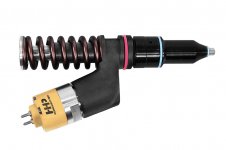
See the blue o ring. That's all that seals the fuel from dumping down the cylinder. Also, that injector is ecm controlled, but if the o rings fails, it don't really matter. If you keep driving, things can get real bad...depending on how much fuel is bypassing down into the cylinder. The tiny o ring on the bottom is designed to burn up and form a carbon ridge creating a compression seal. Usually, that seal and the blue o ring above it are destroyed if there is a fuel leaking into cylinder issue. See the thing that looks like a valve spring on a plunger, that gets pushed down by a rocker arm that's driven by the camshaft. That's what pressures up the fuel inside the injector. The ecm controls when it's injected. Then the cycle repeats. Or at least I assume thats how it's operating, I haven't disected one to see, but it works pretty close to that I'd say. Anyways, it's irrelevant really, but just throwing it out there on how the injection works. You also have to set the injector spring height precisely. Another issue that this style of injection can cause is if the injector sticks open (plunger not down) it beats the cap off of the rocker and will also cause a small amount of low pressure fuel to trickle in on each cycle...usually not a big deal. In that scenario, it don't really cause much of an issue other than a miss and some white hazing smoke. Anyways, sorry I got off topic about cat injectors. It isn't really important to the forum and 2004LBZ's information is relevant. Sorry I got us off track. I just got side tracked on thinking is all. I am giving up on trying to make points about something that don't matter here really. Anyways, I will get my engine back and if I have any more questions, I hope I am still welcome here after this.?
Attachments
Last edited: