03 LB7 Build

Bdsankey

Vendor
Vendor/Sponsor
Feb 1, 2018
4,817
1,862
113
Larsen, Wisconsin
DK Terrible? Maybe for larger fixed vane :) My little lb7 fixed vane loves it, lol.
1767794326657.png
The phrase "fixed vane" makes me want to drown puppies :ROFLMAO:
The BX does sound more like it though. I seem to recall 2400rpm being recommended stall for that turbo around here, and the B10 or BX seem in-line with that ?

As for checking the current converter, if it isn’t installed, you should see the letters written on it in marker. Hopefully they still do that :)
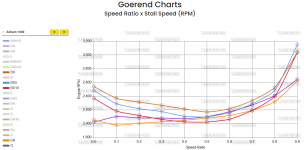
The graph below is at 500ft-lbs of input torque. I included the "G" with the goal of showing that stall speed is only part of the equation for proper converter selection. Look at how the "G" and "DK" have nearly the same rated stall speed but couple (slope/shape of the lines) completely differently.

G: 2020rpm (purple line)
DK: 2054rpm (orange line)
BX10: 2368rpm (red line)
BX5: 2482rpm (blue line)
BX: 2540rpm (brownish/orangeish line)

1767799147966.png
 

LB7StillAlive

Member
Nov 27, 2025
54
34
18
Arizona
I was reading up on the Speed Ratio because, as you said, it’s a relationship of torque. I believe it was impeller rpm divided by turbine rpm (something like that). So, depending on what the torque curve of one’s tuning is, it would adjust the stall speed of the converter, which is what I believe you’re showing on the curves for each style.

I’m still developing an understanding ?. What I believe I understand is this could be where the importance of tuning matters a lot. As well as getting a stall rate to match the performance setup.
 

Bdsankey

Vendor
Vendor/Sponsor
Feb 1, 2018
4,817
1,862
113
Larsen, Wisconsin
I was reading up on the Speed Ratio because, as you said, it’s a relationship of torque. I believe it was impeller rpm divided by turbine rpm (something like that). So, depending on what the torque curve of one’s tuning is, it would adjust the stall speed of the converter, which is what I believe you’re showing on the curves for each style.

I’m still developing an understanding ?. What I believe I understand is this could be where the importance of tuning matters a lot. As well as getting a stall rate to match the performance setup.
These curves are different converter models, nothing more. Same 500ft-lb input torque. It's the only real way that we can compare apples-to-apples on a graph. Now if a customer knows their stall RPM currently I can manipulate the input torque to match with that converter BUT (as you already pointed out) things will be different with tuning and converter changes.

It's a ratio of stator speed to input shaft speed. So at 0.0 we have rated stall speed (tires stopped but against the converter to where it starts pushing through the brakes).

As the vehicle starts to move, the ratio approaches 1 (IE no RPM change across the converter).


This is where builders/shops are critical, we've "been there done that" to hopefully save the end consumer the headache of converter choice.
 
Last edited:

N2BRK

Well-known member
Dec 31, 2009
2,377
712
113
My interpretation of these graphs is that when you are sitting on the line and not moving, you're stall is at the 0.0 speed ratio (adjust for input torque vs the patterned 500ftlbs).

As you start moving your coupling is happening, and at 1.0 you're at lockup.

This might not be 100% on the money, and I'll gladly accept some education here! Using what I opine, you can compare converters on your graph. The G will stall the lowest at take off before moving. Then again at .9 it's the lowest as well. So I expect that it will be coupled very tightly and lockup will be less RPM drop vs say the AX which will be higher on the chart before 1.0.

So if I have a tight little turbo and want to let it's fast spool shine at the tires instead of the tailpipe, I'm going for the low numbers on the graph; G or DK in this case. If I have a larger and lazier turbo, I'm going need more slip and less coupling at low RPM to let it come on the pipe and make power, or else I risk snuffing it out hitting the full vehicle load at low RPM.

I have to say though, I've used a lot of Goerend converters, and while Dave gives more data than anyone, I don't find that it's completely accurate once going down the road vs graphed expectations. You NEED experienced folks to guide your selection. I'll even further that you need like-minded experienced people. Eg. They might favor a loose converter and you might not - you might not be speaking the same language when you ask for a mild converter, lol.
 

Bdsankey

Vendor
Vendor/Sponsor
Feb 1, 2018
4,817
1,862
113
Larsen, Wisconsin
My interpretation of these graphs is that when you are sitting on the line and not moving, you're stall is at the 0.0 speed ratio (adjust for input torque vs the patterned 500ftlbs).
Correct
As you start moving your coupling is happening, and at 1.0 you're at lockup.
You're close, 1.0 would mean that there is no RPM change across the converter. This can be when the converter is finished coupling or when locked up.
This might not be 100% on the money, and I'll gladly accept some education here! Using what I opine, you can compare converters on your graph. The G will stall the lowest at take off before moving. Then again at .9 it's the lowest as well. So I expect that it will be coupled very tightly and lockup will be less RPM drop vs say the AX which will be higher on the chart before 1.0.

So if I have a tight little turbo and want to let it's fast spool shine at the tires instead of the tailpipe, I'm going for the low numbers on the graph; G or DK in this case. If I have a larger and lazier turbo, I'm going need more slip and less coupling at low RPM to let it come on the pipe and make power, or else I risk snuffing it out hitting the full vehicle load at low RPM.
You pretty much nailed it. Picking stall speed and "how" the converter couples are based 100% on usage, parts on the truck, elevation, and even generation of truck. Fixed geometry stuff loves a little bit of "lag" before the load comes in allowing the turbo to get the party started then get loaded up. VGTs love load fast and early, typically (on smaller VGTs) the faster/harder you can load them the better.

Obviously there are outliers or "rules of thumb" to follow.

I have to say though, I've used a lot of Goerend converters, and while Dave gives more data than anyone, I don't find that it's completely accurate once going down the road vs graphed expectations. You NEED experienced folks to guide your selection. I'll even further that you need like-minded experienced people. Eg. They might favor a loose converter and you might not - you might not be speaking the same language when you ask for a mild converter, lol.
This also is true. I have multiple customers who love larger VGTs (think like a 68mm). I personally hate them. They are too lazy for me and I'd rather have a fixed geometry setup at that point where it hits like a Mack truck once the party is started.
 

PureHybrid

Isuzu Shakes IT
Feb 15, 2012
3,886
800
113
Central OH
Probably a good thing Goerend does a free restall, for those that may prefer something slightly different than the 99% of customers. I remember Mike L getting annoyed when people would try to understand and argue about converter characteristics, he always gave off the "trust me I'm the professional" vibe, albeit with good reason
 

Bdsankey

Vendor
Vendor/Sponsor
Feb 1, 2018
4,817
1,862
113
Larsen, Wisconsin
Probably a good thing Goerend does a free restall, for those that may prefer something slightly different than the 99% of customers. I remember Mike L getting annoyed when people would try to understand and argue about converter characteristics, he always gave off the "trust me I'm the professional" vibe, albeit with good reason
99% of customers honestly don't fight. Some think they know what they want but are easily swayed when you provide them examples/logic.
 

ikeG

Oughta Know Better
Apr 19, 2011
2,553
189
63
Western PA
www.facebook.com
View attachment 134095
The phrase "fixed vane" makes me want to drown puppies

The graph below is at 500ft-lbs of input torque. I included the "G" with the goal of showing that stall speed is only part of the equation for proper converter selection. Look at how the "G" and "DK" have nearly the same rated stall speed but couple (slope/shape of the lines) completely differently.

G: 2020rpm (purple line)
DK: 2054rpm (orange line)
BX10: 2368rpm (red line)
BX5: 2482rpm (blue line)
BX: 2540rpm (brownish/orangeish line)

View attachment 134098
Lol. I hate fixed vane but almost hate "fixed geometry" as much. One is definitely more accurate though.

Sent from my SM-G990U2 using Tapatalk
 

LB7StillAlive

Member
Nov 27, 2025
54
34
18
Arizona
At Chevy1925, whomever else might know. I pick up the LB7 on Monday, and will drive it home by the end of the week.

The drive home will finish the break-in, and I’ll do the first oil change on it. After that, I’d like to go get it on a Dyno, which leads me to the question;

where here in Phoenix is a reputable Dyno?

Internet research, one shop pointed me to KC Diesel Shop (used to be OneStop Truck Stop). Sounds like they may have moved, and have been keeping me updated on when they could put me on their dyno (which seems to be getting setup or re-setup). I put a call into Poor Boy Diesel…would love to know where you trust.


Sent from my iPhone using Tapatalk
 

Chevy1925

don't know sh!t about IFS
Staff member
Oct 21, 2009
23,033
8,045
113
Phoenix Az
Kc would be the better of them. Poor boys is meh. Stay away from desert diesel, those guys are absolute hacks

Let me put a text in to a certain someone. He would be the absolute best
 

LB7StillAlive

Member
Nov 27, 2025
54
34
18
Arizona
Looking for a sanity check, really looking for education as I wait for some diagnostics. Short story, I arrived Monday (26th) to get the truck and they let me know it's been having fuel rail pressure issues on Tunes 4 & 5 (last week it had these issues and they thought it was resolved, further driving this weekend the tech noticed it was still happening). It's asking for 25.5k and holds until WOT and then levels off to 23.5-24k. Tunes 1 through 3 hold 25.5k throughout the tune, including wide open throttle. They realized the current Exergy 10mm stroker CP3 pumps use a modified LB7 regulator. As a step in diagnosing the issue, they decided to replace the regulator with an LBZ version, re-worked the tune with PPEI and set off to test the truck. Same rail pressure drop persisted. The shop has tested the lift pump (FASS 165) and it's supplying the proper PSI, they even turned it up to 12psi to see if it would help the situation.

So, they started testing the injectors, balance rates hold fine if not perfectly. They checked the return rate, and nothing out of spec. The build is using a DP Customs fuel block, https://dpcustomsia.com/products/dp-customs-lb7-fuel-distribution-block, which relocates the fuel distribution block and allows a PRV to be used on LB7 trucks. Currently the PRV port is plugged (waiting on the PRV to arrive). The plug is a PPE machined plug. They thought perhaps the plug is not properly sealed and maybe the system is bypassing. They removed, inspected and re-torqued the PRV plug, and no signs of fuel existed. Didn't change FRP issue. They spoke with DP customs and they've pushed north of 30k psi through these blocks, so this piece was eliminated from the equation. They hooked up a bottle to the by-pass port to see if under WOT if it was releasing pressure, bottle returned dry (I was with them during this test). They got with exergy to diagnose potential issues and shared the logs and fuel mapping, exergy is confident the pump is fine...they suggested getting with the tuner. PPEI diagnosed tunes 4 & 5 with the shop in depth and they don't see any anomalies and aren't pushing the setup anywhere close to the max. Based on the setup, PPEI thinks they could push another 100hp if desired, but we purposely have kept it in the "safe" zone. At the same time, my shop let me know that PPEI wouldn't share the pulse width information, as I was curious where the pulse width sat for tunes 4 & 5. Logically contemplating that if the pulse width was too high, it could drain the rail faster than the pump could support. Although the shop contends they've had other setups very similar and this hasn't ever been an issue.

As a reminder the build has 60% Exergy SAC injectors, 165 FASS Pump, New fuel rail lines, 10mm Stroker CP3, S467.7/83 .90 WC Fab Turbo setup. What do you guys think?

At this point the shop is attempting to get a second tuners opinion and if the same conclusion persists, they're going to replace the CP3 pump with a new one and hope it eliminates the issue (although they're searching for someone who has one that isn't buried in snow). The truck is still in their possession as they don't want to hand it over until this is done. As a side note, even with the issues I was all smiles driving in it for the first time (they let me take it for a spin while they were testing the by-pass, in tune 4). Hardly smokes at all and the Torque converter locks at about 2200 rpm. I was happy with how it responded, based on my intended use, and I was surprised how quickly the S467 spooled, very little lag at all. It is making 7-8psi of boost at ~1700 rpms and about 55psi of boost at WOT.

 

Bdsankey

Vendor
Vendor/Sponsor
Feb 1, 2018
4,817
1,862
113
Larsen, Wisconsin
Can you possibly post your logs here? I am wondering if PPEI isn't allowing the regulator current to fall far enough on the larger files. Also, PPEI's answer of "we won't share the pulsewidth information" is frankly a joke. A simple data log will show what their commanded pulse, timing, rail pressure, and current settings are. If you need a PID list that shows these please reach out, I can email it over pretty easily.


I've used a few of DP's fuel blocks on big HP stuff to get rid of the large OEM single stage relief and use the smaller 04.5-10 relief. To clarify, LB7s do have a factory relief already, his block just updates your truck to the late relief and sensor.


What pressure sensor and relief did the shop go with? Is it possible your sensor isn't scaled correctly? I know when I do them I tend to run the LML sensor as it's cheap and ~2100bar (31ksi). I pair them with an S&S single stage 2200bar (32ksi) relief.
 

LB7StillAlive

Member
Nov 27, 2025
54
34
18
Arizona
ogically contemplating that is the pulse wi

Can you possibly post your logs here? I am wondering if PPEI isn't allowing the regulator current to fall far enough on the larger files. Also, PPEI's answer of "we won't share the pulsewidth information" is frankly a joke. A simple data log will show what their commanded pulse, timing, rail pressure, and current settings are. If you need a PID list that shows these please reach out, I can email it over pretty easily.


I've used a few of DP's fuel blocks on big HP stuff to get rid of the large OEM single stage relief and use the smaller 04.5-10 relief. To clarify, LB7s do have a factory relief already, his block just updates your truck to the late relief and sensor.


What pressure sensor and relief did the shop go with? Is it possible your sensor isn't scaled correctly? I know when I do them I tend to run the LML sensor as it's cheap and ~2100bar (31ksi). I pair them with an S&S single stage 2200bar (32ksi) relief.
I'll see if I can get a current log, the truck is still in their possession and I'm currently 4hrs south of the shop until later this week. I'll give them a call when they open and try to find out what relief they used. I'll ask about scaling, or pass along the suggestion. I know them fairly well, but I am also trying not to be the meddling customer who "googles" stuff :). However, I'm hoping it truly is a tuning issue as I hope to drive the truck home to Arizona this weekend, otherwise I'll need to fly up again in a few weeks which is less than ideal.

Agreed on the factory relief. As you know the 3" Y-bridge impedes the factory relief from going back in and often just gets plugged. We decided to use a DP block because it made the routing of the lines cleaner and still allowed a PRV to be used, plus it uses a more updated relief as you mentioned. It's a pretty slick device.

I suspect when you ask "is it scaled correctly?", you're talking about scaling the tuning map in relation to the sensor & regulator? Or are you saying the sensor and regulator get adjusted separately? My pee brain assumes the sensor and regulator are fixed by the manufacturer and are not adjustable beyond their designed parameters. So one would adjust the tuning demands in relation to the sensor and regulator behaviors.
 

Bdsankey

Vendor
Vendor/Sponsor
Feb 1, 2018
4,817
1,862
113
Larsen, Wisconsin
I'll see if I can get a current log, the truck is still in their possession and I'm currently 4hrs south of the shop until later this week. I'll give them a call when they open and try to find out what relief they used. I'll ask about scaling, or pass along the suggestion. I know them fairly well, but I am also trying not to be the meddling customer who "googles" stuff :). However, I'm hoping it truly is a tuning issue as I hope to drive the truck home to Arizona this weekend, otherwise I'll need to fly up again in a few weeks which is less than ideal.
They should be able to send you the logs they sent to PPEI. That's a good place to start.

Agreed on the factory relief. As you know the 3" Y-bridge impedes the factory relief from going back in and often just gets plugged. We decided to use a DP block because it made the routing of the lines cleaner and still allowed a PRV to be used, plus it uses a more updated relief as you mentioned. It's a pretty slick device.

I suspect when you ask "is it scaled correctly?", you're talking about scaling the tuning map in relation to the sensor & regulator? Or are you saying the sensor and regulator get adjusted separately? My pee brain assumes the sensor and regulator are fixed by the manufacturer and are not adjustable beyond their designed parameters. So one would adjust the tuning demands in relation to the sensor and regulator behaviors.
When I mention "scaling" it's referring to the tune being setup properly for your selected rail pressure sensor. For example, if you put an LBZ/LMM or LML or aftermarket rail pressure sensor in without scaling, the reading the ECM is getting isn't actually correct. By changing this in the tune, the 25.5ksi reading is actually 25.5ksi instead of say 20ksi or 30ksi and so on.

Example:

1) LB7 is 0-26.6ksi at 0-5V
2) LML is 0-31ksi at 0-5V

If we assume a linear slope of the line (and an arbitrary value for an offset), 3.5V output from the sensor may be 18.62ksi on an LB7 sensor but is 21.7ksi on the LML sensor. If the tune isn't adjusted for this, you'll end up with more pressure than desired but the truck will have no clue.


It sounds like PPEI already updated your tuning for the LBZ regulator which is good.
 

N2BRK

Well-known member
Dec 31, 2009
2,377
712
113
@Bdsankey Brad - could he just be starting to run out of cp3? 60 over LB7's should be right at the top of the scale for a 10mm, no? I have 65 overs and went to a 12mm and FASS 250.